
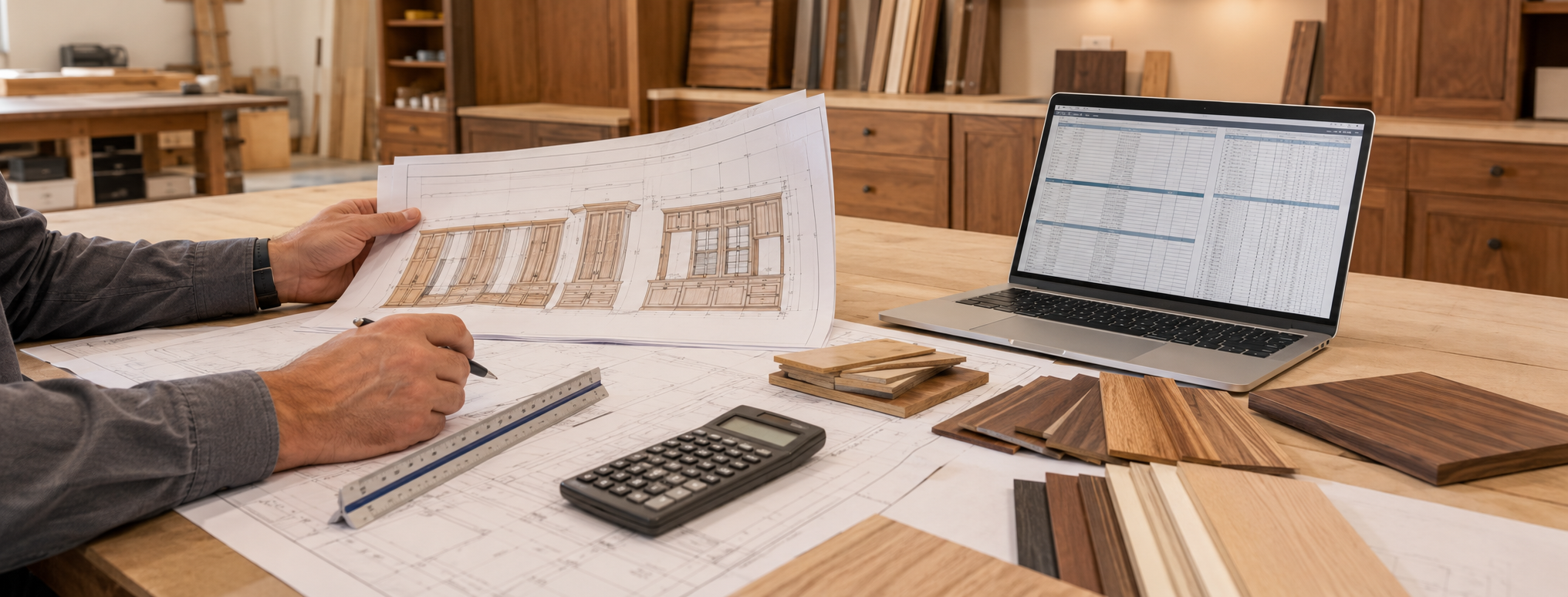
Millwork Estimating Services: A Complete Guide for Contractors
Millwork is one of the most detail-sensitive trades in construction. A single project may include custom cabinets, reception desks, countertops, wall panels, moldings, shelving, doors, and decorative woodwork. Every component can have different dimensions, materials, finishes, hardware, fabrication requirements, and installation conditions.
Even a small estimating error can affect the entire project budget. Missing hardware, using outdated material prices, underestimating fabrication labor, or overlooking installation costs can reduce a contractor’s profit and create delays during construction.
Professional millwork estimating services help contractors convert drawings and specifications into detailed material takeoffs and realistic cost estimates. With an accurately defined scope, contractors can control costs, prepare competitive bids, and make better decisions before accepting a project.
Table of Contents
- What Are Millwork Estimating Services?
- What Is Included in a Millwork Estimate?
- Millwork Estimating vs. Millwork Takeoff
- How Does the Millwork Estimating Process Work?
- Which Projects Require Millwork Estimating?
- Major Cost Factors in Millwork Estimating
- Common Millwork Estimating Mistakes
- Benefits of Professional Millwork Estimating Services
- In-House vs. Outsourced Millwork Estimating
- How Accurate Millwork Estimates Improve Bids
- How to Choose a Millwork Estimating Company
- Why Choose High Q Estimation?
- Frequently Asked Questions

What Are Millwork Estimating Services?
Millwork estimating services calculate the materials, labor, fabrication, finishing, delivery, and installation costs associated with manufactured wood components.
A millwork estimator reviews architectural drawings, interior elevations, schedules, details, and project specifications to identify the complete scope of work. Unlike a general construction estimate covering multiple trades, an architectural millwork estimate focuses specifically on woodwork and related assemblies.
A typical millwork scope may include:
Custom cabinets and cabinetry
Casework and countertops
Doors and wooden frames
Moldings, trims, and baseboards
Wall panels and decorative screens
Shelving and storage units
Reception desks and service counters
Wooden stairs and railings
Custom architectural features
Associated hardware and accessories
Because millwork is frequently custom-made, two components with similar dimensions may have significantly different costs. The estimator must consider the material grade, edge details, hardware, finish, fabrication method, and installation complexity of each component.
What Is Included in a Millwork Estimate?
A professional millwork estimate provides more than a basic list of wood quantities. Depending on the project and the contractor’s requirements, it may include:
Material quantities
Wood species and material grades
Veneers, laminates, and engineered wood products
Cabinet, drawer, door, and shelving quantities
Hardware, fasteners, fittings, and accessories
Shop fabrication labor
Field installation labor
Finishing, staining, painting, or sealing
Equipment requirements
Packaging and transportation
Delivery and unloading
Material waste allowances
Regional labor and material prices
Taxes, overhead, and profit when required
The final deliverables may include an itemized quantity takeoff, marked-up drawings, labor calculations, pricing worksheets, and a bid summary.
The exact scope depends on the available drawings, written specifications, project type, and contractor’s requirements.
Millwork Estimating vs. Millwork Takeoff
A millwork quantity takeoff identifies and measures the materials and components required for a project. A complete millwork estimate adds pricing, labor, equipment, delivery, and other project expenses to those quantities.
| Category | Millwork Takeoff | Millwork Estimate |
|---|---|---|
| Primary Purpose | Identifies and measures the project scope | Calculates the expected project cost |
| Material Quantities | Included | Included |
| Material Specifications | Usually included | Included |
| Material Pricing | Not always included | Included when requested |
| Labor Costs | Usually excluded | Included |
| Equipment and Delivery | Usually excluded | Included when applicable |
| Overhead and Profit | Excluded | Can be included |
| Final Output | Detailed quantity report | Detailed cost estimate or bid summary |
Contractors who already have supplier and labor prices may only need millwork takeoff services. Contractors who need complete support for bid preparation generally require both a takeoff and a cost estimate.
How Does the Millwork Estimating Process Work?
An organized estimating process reduces omissions and makes the final estimate easier to review.
1. Review the drawings and specifications
The estimator examines floor plans, interior elevations, sections, schedules, millwork details, finish schedules, and written specifications. Drawing dates, revisions, and addenda must also be reviewed.2. Define the millwork scope
The estimator identifies what is included and excluded. This step determines whether countertops, hardware, finishing, delivery, and installation are part of the required estimate.3. Identify materials and finishes
Each component is connected to its specified wood species, panel product, veneer, laminate, finish, thickness, and hardware. Alternative materials should not be assumed without authorization.4. Measure quantities
Components are counted or measured in linear feet, square feet, individual units, or another appropriate measurement. Elevations and detailed sections are checked against floor plans to identify items that may not appear on every drawing.5. Calculate material waste
Material waste depends on sheet sizes, grain direction, cutting patterns, custom dimensions, and the complexity of fabrication. A suitable waste allowance helps prevent material shortages and underpricing.6. Estimate fabrication and labor
Labor calculations may include shop drawings, cutting, machining, assembly, sanding, finishing, hardware installation, quality control, transportation, and field installation.7. Apply regional pricing
Material, labor, transportation, and equipment rates should reflect the project location and current market conditions.8. Add indirect costs
Depending on the required scope, the estimate may include equipment, mobilization, supervision, taxes, overhead, and profit.9. Review the estimate
The quantities are compared with schedules, details, specifications, and addenda. This quality review helps identify missing hardware, duplicate items, conflicting finishes, or incomplete pricing.10. Prepare the final report
The final information is organized into a clear report that can support supplier inquiries, internal reviews, procurement planning, and construction bid preparation.Which Projects Require Millwork Estimating?
Millwork estimating services can support many residential and commercial projects, including:
- Custom homes
- Apartment buildings
- Hotels
- Restaurants and cafés
- Retail stores
- Corporate offices
- Hospitals and healthcare facilities
- Schools and universities
- Government buildings
- Entertainment facilities
Residential millwork estimating may focus on kitchens, wardrobes, vanities, built-in shelving, trims, and custom storage.
Commercial millwork estimating often covers reception desks, display fixtures, wall panels, service counters, commercial casework, and repeated assemblies. Commercial projects may also involve strict specifications, phased installation, access limitations, and coordination with several other trades.
Major Cost Factors in Millwork Estimating
The cost of millwork depends on more than its dimensions. The following factors can significantly influence the estimate.
Material type and grade
Solid hardwood, plywood, MDF, particleboard, engineered wood, veneers, and laminates have different prices and fabrication requirements.Design complexity
Curved panels, detailed profiles, concealed connections, custom shapes, and unusual dimensions generally require more fabrication time and skilled labor.Hardware
Hinges, drawer slides, handles, locks, brackets, pulls, and specialty fittings can represent a considerable portion of the final cost.Finishing requirements
Staining, painting, polishing, sealing, fire-retardant treatments, and specialized coatings increase both material and labor costs.Labor rates
Shop fabrication and field installation costs vary by project location, workforce availability, and required skill level.Installation conditions
Restricted working hours, occupied spaces, difficult delivery routes, upper-floor installations, and limited access may increase labor and equipment requirements.Schedule constraints
Fast-track fabrication, phased work, overtime, and short completion deadlines can affect pricing.Material waste
Grain matching, cutting arrangements, sheet optimization, custom dimensions, and possible damage influence usable material yield.Drawing quality
Incomplete or conflicting documents create uncertainty. The estimator may need to include allowances, exclusions, or requests for clarification. For these reasons, contractors should not copy prices from an old project directly into a new bid. A reliable millwork cost estimator adjusts the quantities and prices according to the current scope, location, and market conditions.Common Millwork Estimating Mistakes
Several avoidable mistakes can make a millwork bid inaccurate.
Relying only on floor plans
Important components may appear only in elevations, schedules, or detailed sections. Estimators should review the complete drawing set.Missing hardware
Every cabinet, door, drawer, and custom assembly should be checked for hinges, slides, handles, locks, and other fittings.Ignoring finishes
The estimate should confirm whether shop-applied or field-applied finishes are required and include the necessary materials and labor.Using incorrect measurements
Scaled measurements should be compared with written dimensions and detailed sections.Underestimating material waste
Estimators must consider sheet optimization, grain direction, offcuts, damage, and custom fabrication requirements.Using outdated prices
Material prices and regional labor rates should be verified before submitting the final bid.Omitting fabrication labor
Fabrication includes more than cutting materials. The estimate may need to cover machining, assembly, sanding, finishing, handling, and quality control.Forgetting delivery and installation
Packaging, transportation, unloading, equipment, supervision, and field labor should be included when they fall within the contractor’s scope.Missing drawing revisions
The latest drawing dates, addenda, bulletins, and revised schedules must be reviewed before bid submission.Skipping the final review
The completed estimate should be checked against the bid invitation, scope of work, specifications, and exclusions before it is submitted.Benefits of Professional Millwork Estimating Services
Outsourcing millwork estimating can help contractors when internal teams have limited capacity or several approaching bid deadlines.
Important benefits include:
More complete material takeoffs
Faster bid preparation
Reduced estimating workload
Better cost control
Fewer omissions and duplicate items
Organized reports for supplier pricing
Access to trade-specific estimating knowledge
Support during busy bidding periods
Greater flexibility without hiring permanent staff
More time for operations and project management
Professional estimating cannot guarantee that every bid will be successful. However, it gives contractors a stronger foundation for realistic pricing and informed bidding decisions.
In-House vs. Outsourced Millwork Estimating
| Factor | In-House Estimating | Outsourced Estimating |
|---|---|---|
| Staffing Costs | Requires ongoing salary and employment costs | Pay according to the projects required |
| Estimating Software | Purchased and maintained internally | Usually managed by the service provider |
| Training | Managed and funded by the contractor | The provider supplies trained estimating professionals |
| Availability | Limited by the internal team’s workload | Can provide additional support during busy bidding periods |
| Company Knowledge | Strong understanding of internal processes and pricing methods | Requires clear scope details and communication |
| Scalability | Additional workload may require hiring more staff | Easier to scale according to the current bid volume |
| Turnaround Time | Depends on internal workload and available staff | Can provide flexible support for approaching bid deadlines |
| Best Suited For | Companies with regular and high-volume estimating requirements | Companies with variable workloads or specialist support needs |
An in-house estimator may be ideal for a company with consistent bidding volume and established internal systems.
Outsourcing can be cost-effective for small and medium-sized contractors, companies entering new markets, and teams requiring temporary support. Some contractors use a hybrid approach by outsourcing detailed takeoffs while keeping supplier negotiations and final pricing decisions in-house.
How Accurate Millwork Estimates Improve Construction Bids
Accurate millwork estimates help contractors:
Establish realistic bid prices
Protect expected profit margins
Identify cost risks
Compare supplier quotations
Plan material procurement
Estimate labor requirements
Avoid underbidding
Prepare organized proposals
Submit bids with greater confidence
For example, suppose an estimator includes the panels and countertop for a commercial reception desk but omits the specialty drawer slides, locks, decorative hardware, finishing, and installation labor.
The bid may initially appear competitive, but the missing items must still be purchased and installed. These unplanned costs could absorb the contractor’s expected profit.
A detailed estimate identifies these expenses before the bid is submitted. The contractor can then adjust the price, request clarification, consider alternative materials, or include an allowance.
How to Choose a Millwork Estimating Company
Before choosing a millwork estimating company, contractors should consider whether it offers:
Experience reading architectural drawings
Knowledge of millwork materials and fabrication
Understanding of finishes and hardware
Clearly defined inclusions and exclusions
Organized quantity and pricing reports
Regional pricing knowledge
Reliable communication
Reasonable turnaround expectations
Confidential handling of project documents
Revision and addendum support
Residential and commercial estimating experience
A quality-review process
The cheapest estimating service is not necessarily the best option. The final estimate should be detailed, understandable, and suitable for the contractor’s bidding and procurement process.
Why Choose High Q Estimation?
High Q Estimation supports contractors, subcontractors, builders, developers, and construction companies throughout the USA and Canada.
Our millwork estimating services convert project drawings and specifications into organized information that can support bidding, budgeting, and project planning.
Depending on your requirements, our services can include:
- Millwork quantity takeoffs
- Labor and material cost estimates
- Cabinet and casework estimating
- Residential millwork estimating
- Commercial millwork estimating
- Trade-specific estimating reports
- Construction bid preparation support
- Material takeoff services
- Quantity takeoff services
- High Q Estimation carefully reviews the available documents, identifies the required scope, and prepares deliverables based on your project requirements.
Frequently Asked Questions
Millwork estimating services may include material quantities, wood specifications, cabinetry, hardware, fabrication labor, finishing, delivery, installation, equipment, waste allowances, and regional pricing. The precise scope depends on the project documents and whether the contractor needs a takeoff or complete cost estimate.
The cost depends on the project’s size, complexity, drawing quality, required deliverables, and deadline. A small residential cabinetry takeoff usually requires less work than a commercial project containing custom casework, counters, wall panels, and multiple finish types.
Turnaround time depends on the number of drawings, project complexity, requested level of detail, revisions, and current workload. Contractors should provide the required bid date when requesting a quote.
Useful documents include architectural plans, interior elevations, sections, millwork details, door and finish schedules, reflected ceiling plans, specifications, addenda, and the latest drawing revisions.
A preliminary takeoff or budget estimate may be prepared from incomplete drawings. However, all assumptions, allowances, and exclusions should be clearly documented. The estimate should be updated when final drawings become available.
Millwork covers a broad range of manufactured architectural wood components, such as doors, trims, wall panels, reception desks, and cabinetry. Casework generally refers to box-shaped storage components, including cabinets, shelving, and built-in units.
A complete estimate can include shop fabrication labor, finishing, transportation, field installation, equipment, and supervision. A quantity-only takeoff may not include these costs, so contractors should clearly define the required scope.
Yes. Millwork takeoffs can be prepared for offices, hotels, restaurants, retail stores, hospitals, educational buildings, apartment developments, and other commercial projects.
Outsourcing helps contractors manage busy bidding periods, reduce the time spent measuring drawings, and obtain trade-focused estimating support without hiring additional permanent staff.
Send High Q Estimation your latest drawings, specifications, addenda, project location, required scope, preferred deliverables, and bid deadline. The team can review the documents and provide a customized quote.
Get a Detailed Millwork Estimate for Your Next Bid
Millwork bids require careful coordination of quantities, materials, finishes, hardware, fabrication, transportation, and installation. Professional millwork estimating services help contractors reduce omissions, understand project costs, and prepare bids based on a clearly defined scope.
If you need support with an upcoming residential or commercial project, Contact High Q Estimation and submit your drawings for a customized quote. Our team can prepare a detailed millwork takeoff or cost estimate based on your specific project requirements.